Fire Extinguisher
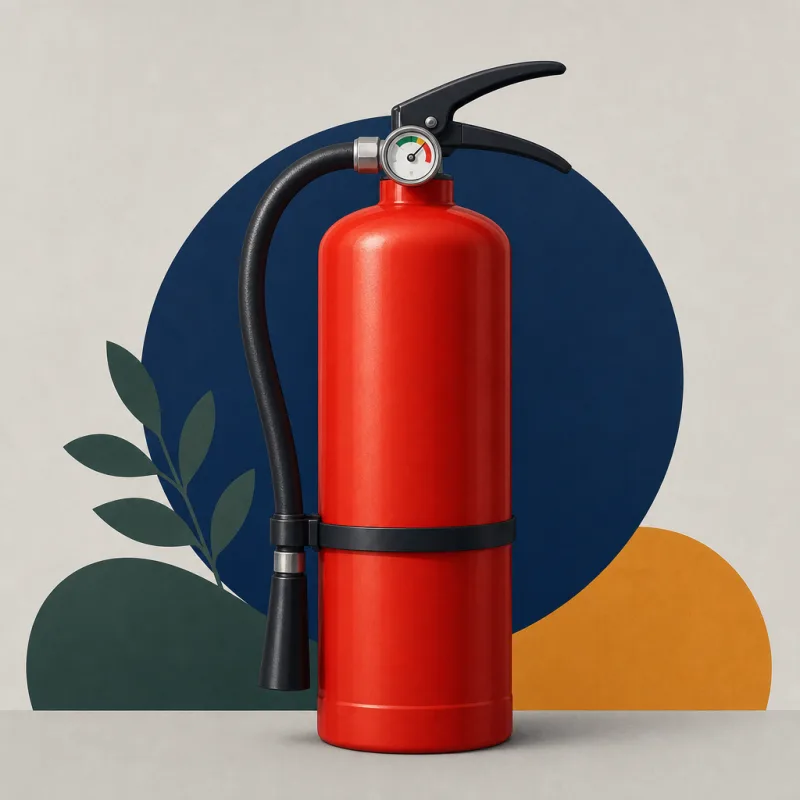
Rechargeable fire extinguishers last 10 to 12 years before replacement or hydrostatic testing. Check the gauge monthly and have a professional inspect it yearly.
Not decay but inspection
A fire extinguisher does not spoil, but it loses reliability over the years — and in an emergency every second counts. Under NFPA 10, the guiding standard in the US, extinguishers need a quick visual check by the owner every month and a thorough inspection by a professional once a year.
Beyond those checks, every extinguisher has a limited overall life. Rechargeable models should be hydrostatically tested about every 12 years and are generally replaced after 10 to 12 years, as the cylinder and valve age. Disposable (non-rechargeable) extinguishers cannot be serviced and should simply be replaced after about 12 years or as soon as the gauge drops out of the green.
A quick self-check between inspections is the pressure gauge: if the needle sits in the green zone, the pressure is right. If it is in the red — too low or too high — the extinguisher needs professional service or replacement. With dry-powder models the powder can compact over time; occasionally turning and gently shaking the extinguisher keeps it loose.
Just as important as the technical state is the location. An extinguisher only helps if it is quickly to hand in an emergency — clearly visible, not hidden behind furniture or deep in the basement. And it should be kept out of both blazing sun and freezing cold, as both stress the pressure and the agent. Mind these points and you have a reliable device ready when it matters.
How do I spot an extinguisher that is due?
Three signals show that action is needed:
If the needle is in the red, the pressure is wrong — then it needs professional service.
The tag records the last and next service; if the date has passed, have it inspected.
Dents, rust, a damaged hose or hardened powder are clear signals to retire it.
Inspection and replacement at a glance
Checks and overall life run in parallel:
| Situation | Interval |
|---|---|
| Owner visual check | monthly |
| Professional inspection | yearly |
| Hydrostatic test / replace (rechargeable) | about every 12 years |
| After any use (even partial) | recharge at once |
Check & keep it ready
This keeps the extinguisher reliable when it counts:
Mount it within reach — clearly visible and quick to grab, not stored in the basement.
Watch the tag — note the next service date.
Protect from extremes — do not store it in blazing sun or freezing cold.
Recharge after use — even a brief discharge loses pressure and needs professional service.
Common myths
A few myths surround the fire extinguisher:
No — check it monthly, service yearly, and replace after about 10 to 12 years.
Not necessarily — only the inspection and the gauge show the real state.
No — after any discharge it must be recharged, or it will fail next time.
The right class matters: a grease fire in the kitchen must never be put out with water — there a fire blanket or a Class K wet-chemical extinguisher is the tool. A common home recommendation is a multipurpose ABC extinguisher on each floor, plus one in the kitchen and garage.