Car Battery
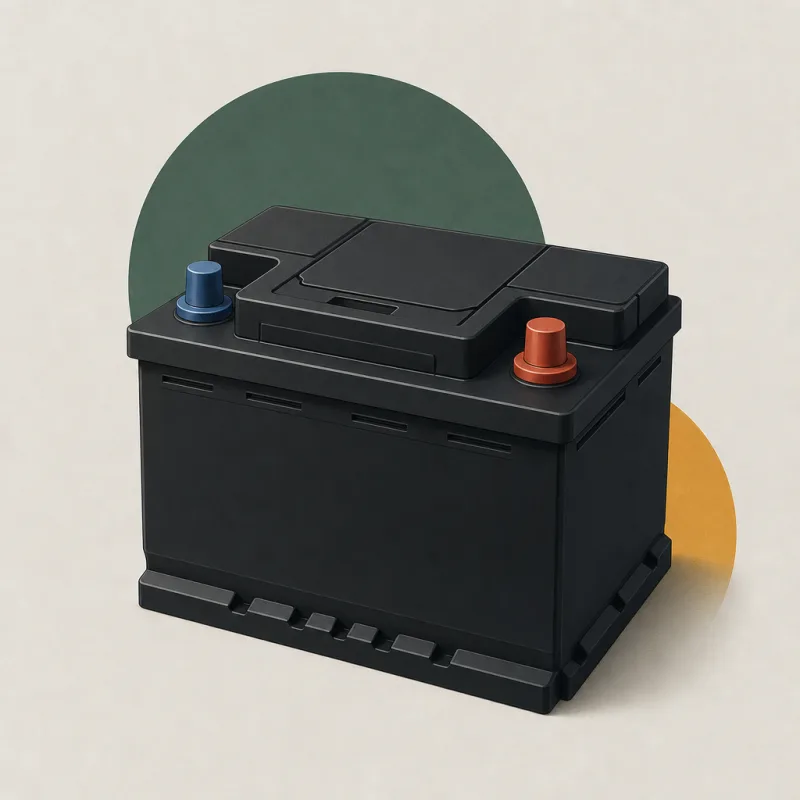
A car battery lasts 4 to 6 years on average. Short trips, heat and cold shorten its life — sluggish cranking is the first warning sign.
Four to six years — with big outliers
A starter battery (lead-acid or AGM) lasts four to six years on average. But that is only a guideline: driving pattern and climate have an enormous influence. Some batteries give up after three years, others last eight — at otherwise equal quality.
The biggest lifespan killer is the short trip. On short drives the alternator never fully charges the battery, while ignition, lights and electronics constantly draw current. A chronically half-empty battery sulfates and ages fast. Extreme summer heat (which drives self-discharge) and deep winter cold (which lowers available starting power) also take their toll. In hot southern climates especially, batteries often last barely three years.
The first warning sign is sluggish, slow cranking, especially in the morning and in the cold. Other signs are dimming lights, a glitchy stop-start system or a battery warning light on the dash. Take these signals seriously and you get stranded less often — a weak battery almost always fails at the worst moment.
A simple voltage test with a cheap multimeter gives certainty: the resting voltage (engine off, parked for a few hours) is around 12.6 volts on a full battery. Readings below 12.4 volts show a weak battery, below 12.0 volts a nearly empty one. Many shops and auto-parts stores also test the battery under load for free — which tells you more than voltage alone.
How do I spot a weak battery?
An ageing battery usually gives warning:
The starter turns audibly slower than usual in the morning or in the cold.
Headlights dimmer, stop-start refuses, or the battery warning light on the dash comes on.
Measure resting voltage: about 12.6 V = full, below 12.4 V = weak, below 12.0 V = nearly empty.
Lifespan at a glance
Driving pattern and climate set the range:
| Condition | Lifespan |
|---|---|
| Average | 4–6 years |
| Lots of short trips | often only 3–4 years |
| Long drives, mild climate | up to 8 years |
| Resting voltage < 12.4 V | weak, test/charge |
Use longer & care
This keeps the battery fit longer:
Plan longer drives — give the alternator time to fully charge the battery.
Charger in winter — during idle periods and cold, top up with a maintenance charger.
Keep terminals clean — corroded, oxidised terminals raise resistance.
Switch off loads — do not run lights and electronics with the engine off.
Common myths
A few myths surround the car battery:
It usually warns you with sluggish cranking — watch for it and you replace it in time.
Heat in particular harms it: it drives self-discharge, and many batteries die after the summer.
On modern cars the new battery often has to be registered or coded, or the electronics will not play along.
Before replacing a supposedly dead battery, it is worth trying to charge it with a suitable charger: often it is only deeply discharged, not faulty. Old batteries do not belong in household waste but go to a collection point or back to the retailer — a core charge usually applies anyway.