Brake Fluid
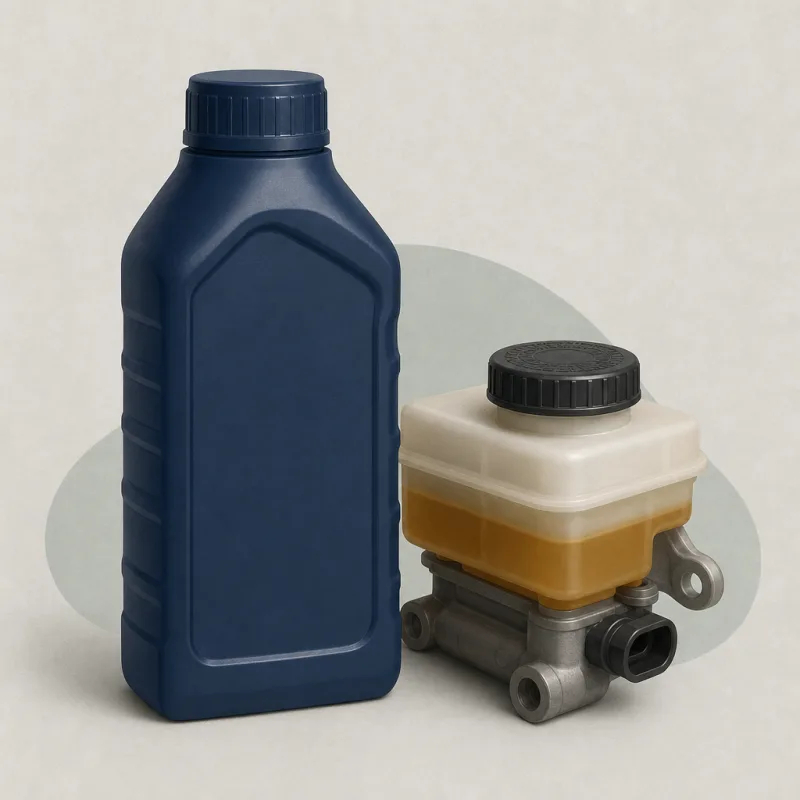
Change brake fluid every 2 to 3 years — regardless of the miles driven. It absorbs water and loses its braking safety over time.
Every two to three years — for safety
Brake fluid is a safety-critical component and should be changed about every two to three years — regardless of how many miles you have driven. The reason lies in a special property: brake fluid is hygroscopic, meaning it draws water from the air over time, even in the sealed system.
This absorbed water lowers the fluid's boiling point. Under heavy use — long downhill stretches or repeated hard braking — the brake fluid can then start to boil locally. Vapour bubbles form, and because gas compresses where liquid does not, the brake pedal goes soft and in the worst case the brake can fail. That is exactly what makes the regular change so important.
Signs of old brake fluid are not always obvious in everyday driving. A soft, spongy brake pedal, a brake warning light or a clearly dark discolouration of the fluid in the reservoir are warning signs. The water content itself can only be checked reliably with a special tester at the shop — so the two-to-three-year interval is the safest rule of thumb.
The right type also matters. Vehicles use different DOT grades depending on the spec (such as DOT 4 or DOT 5.1), with different boiling points and properties. These should not be mixed at random. The change belongs at a shop, because the brake system has to be properly bled — air in the system would have the same dangerous effect as vapour bubbles.
How do I spot old brake fluid?
Three signals point to a change being due:
If the pedal feels spongy or sinks further, there may be water in the system.
Fresh brake fluid is light and clear; dark, cloudy fluid in the reservoir is a warning sign.
If the brake warning light comes on, take the vehicle straight to a shop.
Change interval at a glance
Time beats mileage — the fluid ages even parked:
| Situation | Change |
|---|---|
| Regular change | every 2–3 years |
| Soft pedal / warning light | have it checked at once |
| Dark, cloudy fluid | change |
| Wrong/mixed DOT grade | replace properly |
Check & keep it safe
This keeps the brakes reliable:
Change every 2–3 years — regardless of mileage, ideally with a service.
Check the level — watch the reservoir; a dropping level points to wear or a leak.
Right DOT grade — use only the grade specified by the maker, do not mix.
Go to a shop — the change requires proper bleeding of the system.
Common myths
A few myths surround brake fluid:
No — it absorbs water even parked, so time counts: every two to three years.
Not necessarily — under heavy load old fluid can suddenly fail, though it seemed fine in daily use.
Topping up is no substitute for a change — the absorbed water stays in the system.
The brake-fluid change is often done together with a major service but shows up as a separate line on the bill. If you do not know the last change, find it in the service book or have the water content measured at a shop. When buying a used car, brake fluid is one of the things worth renewing to be safe.