Honey
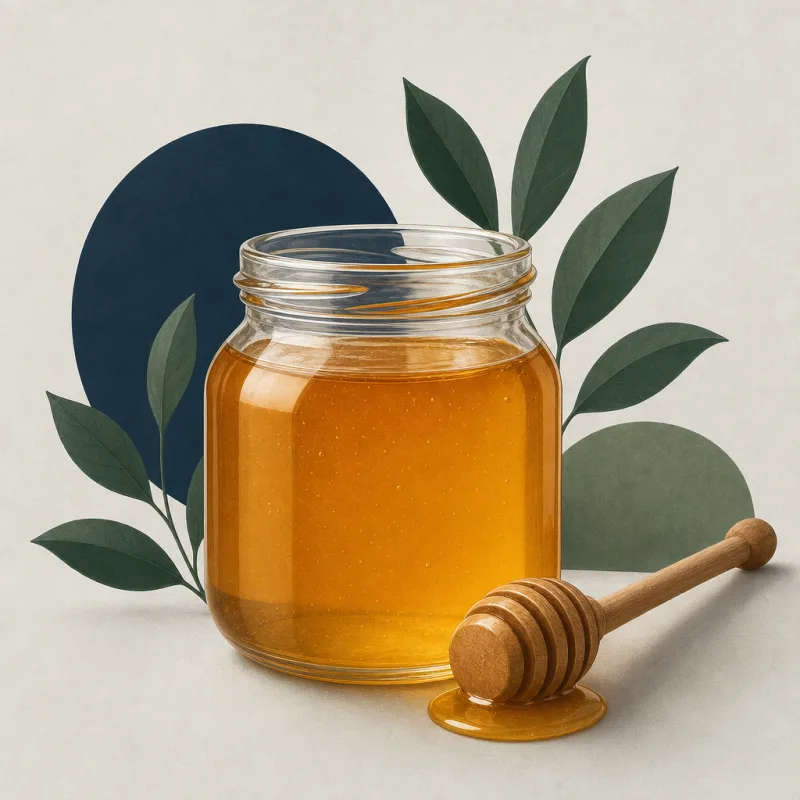
Honey lasts virtually forever. Kept sealed and dry it stays good for years — the Best-By date is a formality, not a spoilage date.
Why honey lasts practically forever
Honey is one of the few foods that barely spoils, and that comes down to its makeup. It naturally holds very little free water, is mildly acidic with a pH around 3.5 to 4.5, and releases small amounts of hydrogen peroxide through a bee enzyme. For bacteria and mould that is a hostile place: there is neither enough moisture nor the right conditions to grow.
That is why pure, properly stored honey stays good for years. The Best-By date on the jar is a labelling requirement, usually two to three years out, and tells you little about whether the honey is still fine. Honey found sealed in ancient Egyptian tombs was still chemically intact after thousands of years.
Crystallised is not spoiled
Almost all honey turns thick, cloudy and creamy over time — this is crystallisation, a completely natural process and not a sign of spoilage. How fast it happens depends on the variety: some honeys granulate within weeks, others stay runny for a long time. To bring it back, stand the jar in a warm water bath no hotter than about 104 °F (40 °C). Skip the microwave and high heat — both destroy the valuable enzymes and the delicate aroma.
Crystallised, solid honey is not spoilage — a warm water bath makes it liquid again. A real warning sign is fermentation: if the honey smells sour and alcoholic or forms foam on the surface, it had too much moisture and has spoiled.
How do I know it is off?
Spoiled honey is rare, but there are clear warning signs — especially if moisture has got into the jar:
If honey smells fermented or forms bubbles and foam, it has taken on too much water and started to ferment. Discard it.
Very rare, but possible in honey that has absorbed moisture. If you see mould, do not use it.
Water, butter or food bits in the jar shorten its life dramatically — always use a dry, clean spoon.
Shelf life at a glance
Whether and how long honey keeps is mostly decided by moisture. This table shows the typical cases:
| State | Shelf life |
|---|---|
| Unopened, stored dry | many years |
| Opened, kept clean | 1–2 years and beyond |
| Crystallised | good indefinitely |
| Fermented / wet | discard |
Store it right
Honey needs no special care, but a few rules keep it good for the long haul:
Dry, at room temperature — not in the fridge, where honey crystallises faster.
Seal the jar well — honey draws moisture from the air, which invites fermentation.
Keep it dark — light slowly degrades aroma and enzymes.
Always a dry spoon — no water, no crumbs in the jar.
Common myths
Because honey lasts so long, plenty of half-truths circulate:
Not true — crystallisation is natural. A warm water bath makes it runny again and it is perfectly safe.
No — sealed and stored dry, honey is good far beyond it. The date is only a formality.
The opposite: cold makes it granulate faster. Room temperature is ideal.
Do not give honey to infants under 12 months. It can contain spores of Clostridium botulinum that may germinate in a baby's immature gut and cause infant botulism. For older children and adults, honey is completely safe.