Water Filter
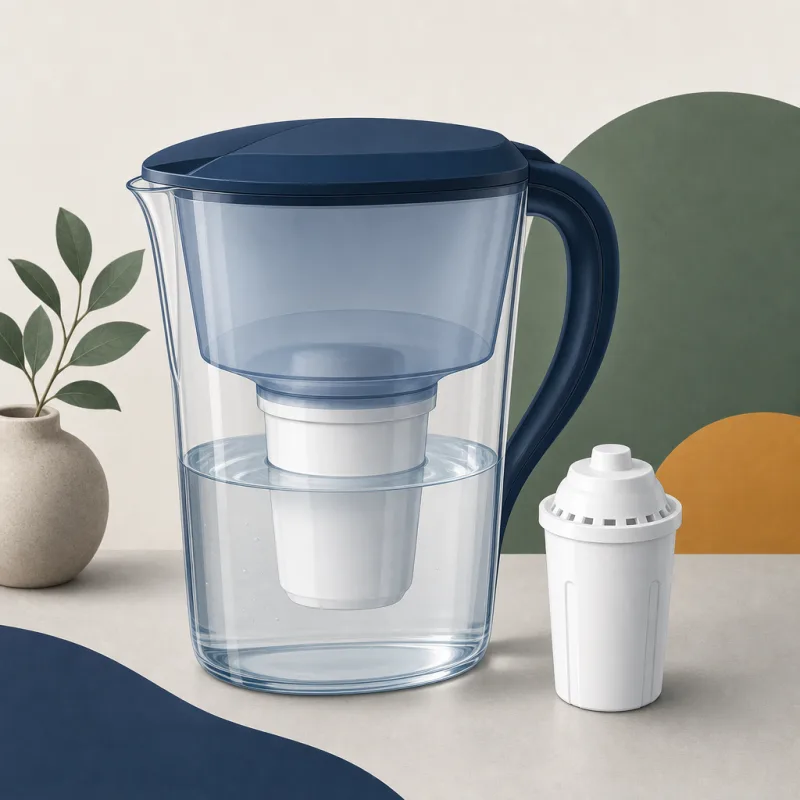
Change a pitcher filter cartridge about every 2 months or per the maker gauge. An overdue cartridge can grow bacteria.
Pitcher filters every ~2 months, regardless of use
How often you must change a water filter depends on the type. For the common pitcher filters (such as Brita), makers recommend replacing the cartridge about every two months or after roughly 40 gallons — whichever comes first. In the US the interval is often stated as two months; the time interval matters even if you have used little water, because it is not only about filter capacity.
The reason for the fixed schedule is hygiene. The cartridge binds chlorine, taste and odor compounds, and many contain activated carbon. In the damp, nutrient-rich filter medium bacteria can multiply over time — especially if the pitcher stands warm and the water sits in it for long. An overdue cartridge then no longer improves the water and can even burden it with germs.
Built-in filters work differently. Activated-carbon faucet or under-sink filters and reverse-osmosis systems have much longer intervals depending on design and water hardness — usually six to twelve months, and some membranes last years. Here the maker sets the service life, often backed by a change indicator or flow counter. These filters should not be overrun either.
Whatever the type: filtered water is not preserved germ-free but should be used up promptly. It is best to keep the pitcher in the fridge and drink the water within a day or two. That preserves the benefit the filter brings for taste and hardness.
How do I spot a due cartridge?
Several signs point to a change:
The electronic change indicator or the set two-month date is the most important signal.
If the water tastes more clearly of chlorine again, the cartridge is spent.
If the water runs noticeably slower, the filter is clogged.
Change interval at a glance
The filter type sets the interval:
| Filter type | Change |
|---|---|
| Pitcher cartridge | ~2 months / 40 gal |
| Faucet carbon | 2–6 months |
| Under-sink | 6–12 months |
| Reverse-osmosis membrane | several years |
Care & use hygienically
This keeps the filter reliable:
Change the cartridge on time — pitcher every 2 months, even with little use.
Clean the pitcher regularly — rinse jug and lid to avoid biofilm.
Use water promptly — do not let it stand for days.
Store in the fridge — chilled filtered water stays fine longer.
Common myths
A few myths surround water filters:
No — the time interval matters for hygiene too, not just taste.
No — it should be drunk promptly and chilled, or germs can multiply.
US tap water from public systems is regulated; the filter mainly improves taste and hardness.
Public tap water in the US is regulated under the Safe Drinking Water Act and is generally safe to drink. A pitcher filter is therefore usually a matter of taste and hardness, not a safety gain — and only worthwhile if the cartridge is changed on time, or the benefit turns into its opposite. Knowing the hardness of your tap water helps judge whether a filter is worthwhile at all: in areas with very soft water it brings little benefit, while in hard-water regions it mainly improves the taste of coffee and tea. Your local water utility can usually provide a hardness figure on request.