Dishwasher
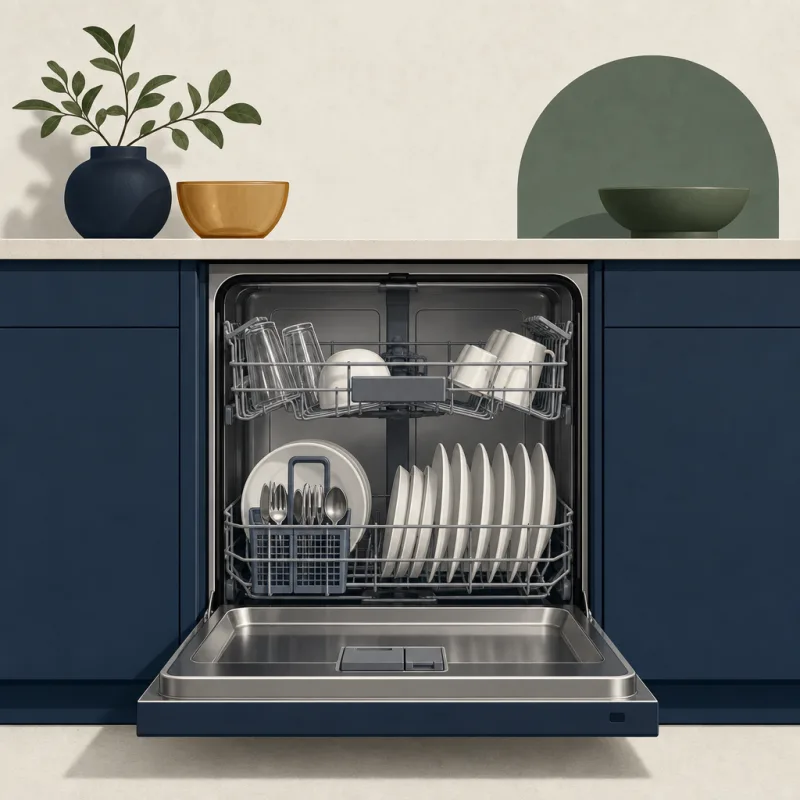
A dishwasher lasts about 10 years on average. For many faults a repair is worth it — cheaper and greener than buying new.
Why about 10 years?
A dishwasher is a hard-working machine: it pumps hot water, works with detergents and often runs daily. Over the years moving parts like the pump, seals and spray arms wear out, and lime scale takes its toll on the interior. On average a dishwasher therefore lasts about ten years — quality models longer, budget ones often a bit less.
The key point: not every fault is the end. Many typical problems — a clogged filter, a failed pump, a leaking door, a broken heating element — can be repaired, often for a fraction of a new machine. For units under about eight years old, that is almost always worth it, both financially and environmentally.
Making a new dishwasher takes a lot of energy and raw materials. A repair is therefore almost always the greener choice. Descaling, cleaning the filter and swapping small parts often add years of life — good for your wallet and the planet.
Source: EPA / ENERGY STARHow do I know it is nearing the end?
These signs call for a repair or — on old machines — replacement:
If dishes stay spotty despite a clean filter and rinse aid, the spray arms, pump or heater are often at fault.
Puddles under the machine point to worn door seals or hoses — have it fixed before water damage occurs.
A rusting interior or recurring error messages on a machine over ten years old argue for a new one.
Repair or replace?
This rule of thumb helps you decide:
| Situation | Recommendation |
|---|---|
| Under 8 years, single fault | repair almost always pays |
| Repair under 50 % of new price | repair |
| Over 10 years + costly fault | consider replacing |
| Rust / multiple faults | replace (with an efficient model) |
Make it last: care for it right
With a little care a dishwasher lasts noticeably longer:
Clean the filter regularly — food scraps in the bottom filter are the most common cause of poor cleaning and odours.
Descale regularly — a special cleaner or a cycle with citric acid protects the heater and pump.
Refill salt and rinse aid — matched to your water hardness; it protects the mechanics and improves results.
Open the door after washing — so the interior dries and no musty smell develops.
Common myths
A few half-truths surround dishwashers:
Wrong — many faults are cheap to repair, especially on younger units.
Unnecessary — scrape off big scraps and modern machines and detergents do the rest. Pre-rinsing wastes water.
Not needed — the eco cycle cleans thoroughly at a lower temperature and saves the most energy.
When buying new, check the energy label — an efficient machine saves noticeable electricity and water over ten years. And old units do not belong in the trash — take them to recycling free of charge, or have the retailer take the old one back on delivery.